


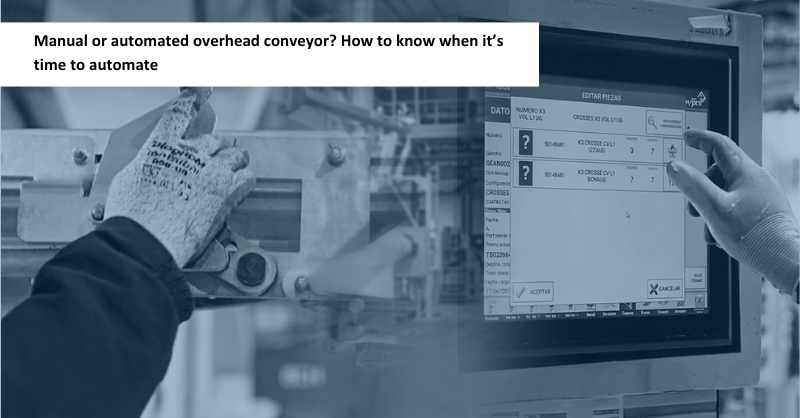
In certain industries and applications, overhead conveyors are an effective solution for improving internal material flows, maximizing available space, and keeping parts suspended between processes. Once this technology has been identified as the best fit, the next question naturally arises:
Should you choose a manual or automated overhead conveyor? Or, put another way, does a manual system adequately meet the process requirements, or is it time to automate?
At first glance, the answer seems obvious. Automation is often associated with higher productivity, greater control, real-time traceability, and reduced human intervention. However, the reality is far more nuanced.
There are manual installations that operate efficiently for decades, while some automated systems add little value because they were implemented in processes where automation was not truly necessary.
For that reason, the right question is not “Should I automate?” but rather:
“Is my material flow still reasonably manageable through manual operation?”
After all, both manual and automated overhead conveyors can store, transport, sequence, and feed production processes. The difference is usually not what they can do, but how much effort is required to manage the flow as complexity increases.
Automation is not always the answer
Over the last few decades, industry has experienced a strong trend toward digitalization and automation. Yet automating simply for the sake of automating is rarely a good strategy.
An automated overhead conveyor system requires a higher investment, more advanced control systems, and greater technical complexity. Before taking that step, it is important to assess whether the current challenges truly justify the investment.
In many cases, a well-designed manual solution can deliver the performance the operation needs while offering lower investment costs, reduced maintenance requirements, and greater flexibility to adapt to future changes.
The key is not to automate more, it is to automate what truly adds value to the process.
What a manual overhead conveyor can do
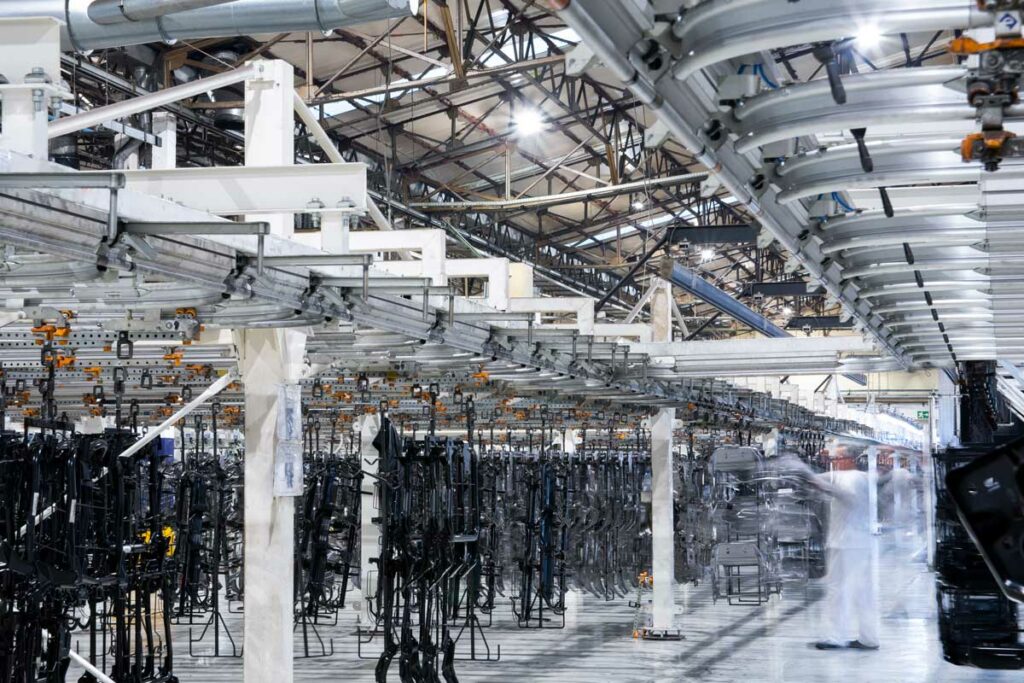
There is a common misconception that a manual overhead conveyor is simply a basic or limited version of an automated system.
That is far from the reality.
Modern manual solutions can perform advanced logistics functions such as:
- FIFO storage.
- Product accumulation.
- Sequence preparation.
- Workstation feeding.
- Efficient use of vertical space.
- Visual flow management.
- Quick adaptation to layout changes.
- Intermediate buffers between processes.
In fact, many industrial plants successfully manage Just-in-Time (JIT) replenishment and Just-in-Sequence (JIS) production flows manually every day.
The difference is that sequence management relies on people rather than control software.
This is why manual industrial conveyors remain highly attractive when companies are looking for:
- Operational simplicity.
- Mechanical robustness.
- Flexibility.
- Low initial investment.
- Easy adaptation.
- Reduced maintenance costs.
What an automated overhead conveyor really adds
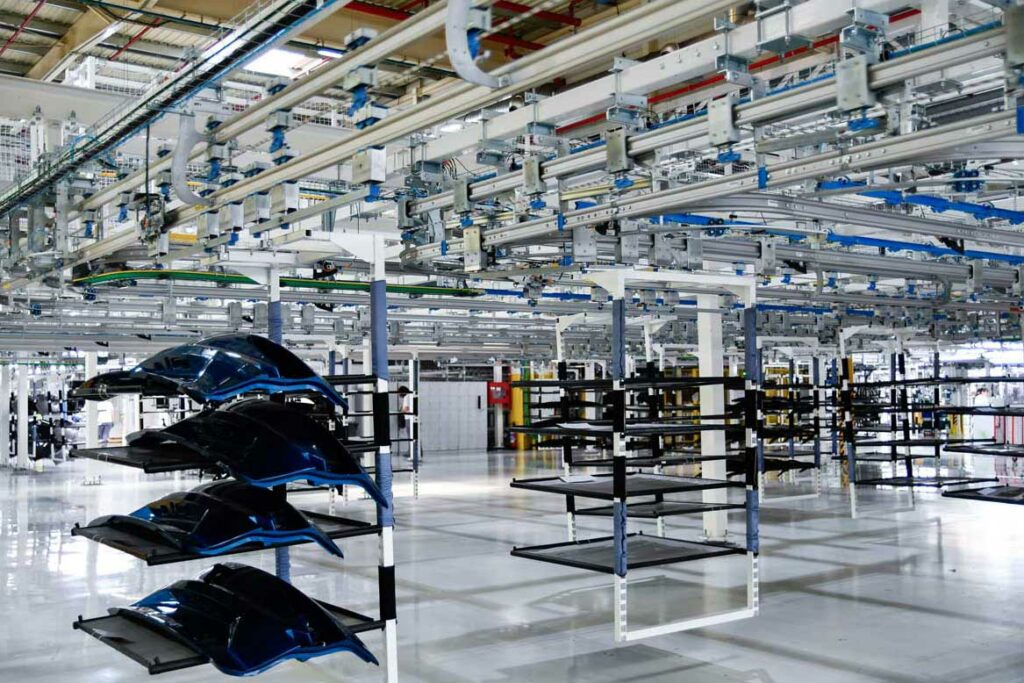
Automation is not just about moving loads without human intervention.
Its real value becomes apparent as logistics complexity increases.
As the number of SKUs, production sequences, movements, data points, and traceability requirements increases, manual management becomes increasingly difficult.
That is when an automated overhead conveyor starts taking over not only movement tasks but also management and control functions.
For example, it can:
- Manage storage locations automatically.
- Control production sequences.
- Record movements in real time.
- Update inventory levels.
- Communicate with MES systems.
- Optimize transport routes.
- Reduce operational errors.
- Improve product traceability.
In other words, automation does more than eliminate physical transportation tasks.
It also simplifies the management of material flow.
More than transportation: accumulation as a way to decouple processes
Although we are discussing overhead conveyors, one of the most requested functions in these installations is part accumulation.
Both manual and automated systems can incorporate accumulation rails or storage points that act as intermediate buffers within the production flow. In Esypro solutions, this capability can be integrated into both manual and automated installations, adapting to the specific requirements of each process.
These accumulation areas allow temporary storage of parts between operations that do not necessarily operate at the same pace.
For example, one process may run continuously while the next operates in batches, performs product changeovers, or experiences occasional stoppages. Without an accumulation zone, any difference in operating speed can lead to waiting times, blockages, or production interruptions that spread throughout the line.
A buffer absorbs these variations and decouples both processes. As a result, a brief incident, operational pause, or capacity mismatch does not necessarily force the upstream process to stop immediately.
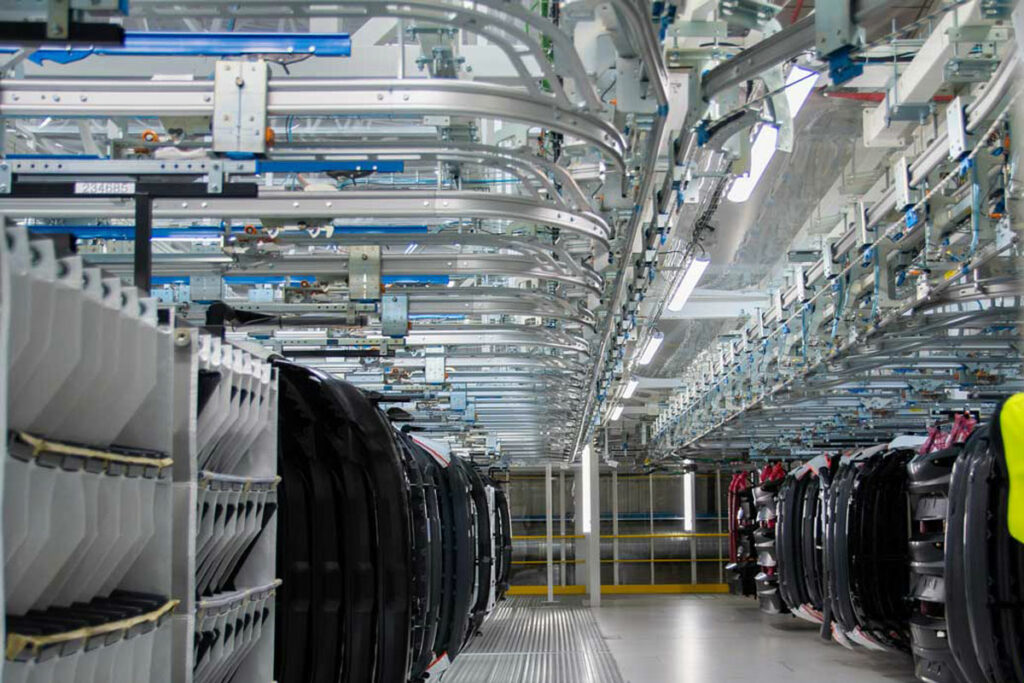
Accumulation can also be used to:
- Maintain inventory close to the point of use.
- Organize references before feeding production.
- Manage FIFO flows.
- Prepare manufacturing sequences.
- Absorb temporary demand fluctuations.
- Prevent small interruptions from affecting the entire installation.
- Make better use of vertical space.
Accumulation is not exclusive to manual systems. It can also be integrated into automated conveyors, where the system itself manages locations, priorities, and release sequences according to production requirements.
Signs that a manual overhead conveyor is still the best solution
There are many situations where a manual solution continues to be the most efficient option.
This is typically the case when:
- The number of SKUs is low or moderate.
- Layout changes are frequent.
- Production is relatively stable.
- Traceability requirements are basic.
- Operators work close to loading and unloading areas.
- Sequences can be managed visually with ease.
- The ROI of automation is difficult to justify.
In these situations, simplicity often becomes a competitive advantage.
Fewer components mean less maintenance, lower technical complexity, and greater adaptability to future changes.
Signs that it may be time to automate
There are also situations where an automated overhead conveyor begins to create clear value.
Some of the most common indicators include:
- The number of SKUs is continuously increasing.
- Sequencing errors begin to appear.
- Operators spend excessive time moving materials.
- Real-time traceability becomes necessary.
- Integration with MES systems is required.
- Accumulation areas, routes, or destinations become increasingly difficult to manage manually.
- Managing the flow manually becomes increasingly resource-intensive.
- Customers demand greater process control.
- Time and resources dedicated to managing material flow continue to grow.
When several of these situations occur simultaneously, it is often a sign that logistics complexity has exceeded what can reasonably be managed manually.
Manual or automated overhead conveyor: comparison
| Aspect | Manual Overhead Conveyor | Automated Overhead Conveyor |
|---|---|---|
| Initial investment | Lower | Higher |
| Technical complexity | Low | Medium–High |
| Maintenance | Very low | Low–Medium |
| Flexibility for changes | High | High |
| FIFO management | Possible | Automatic |
| JIT/JIS sequencing | Possible | Automatic |
| Vertical space utilization | Very good | Excellent |
| Traceability | Basic | Advanced |
| MES integration | Limited | Complete |
| Management of many SKUs | More demanding | Easier |
| Manual movements | High | Reduced or eliminated |
| Scalability | High | High |
As with any industrial project, this table should not be interpreted as an absolute rule.
Ergonomics matter too
From an ergonomic perspective, automated conveyors have an obvious advantage: parts move without human intervention.
However, this does not mean that manual conveyors require significant physical effort. Since parts remain suspended from the rail system throughout the process, the weight of the load is supported by the installation itself. Operators simply push or pull the carriers.
This configuration allows one or several connected parts to be moved comfortably without removing them from the conveyor or manually carrying them between processes.
Furthermore, a manual or automated overhead conveyor can incorporate different loading and unloading solutions. These operations may be performed manually in either system, but they can also be assisted by manipulators or integrated with robotic systems for full automation.
Therefore, the main ergonomic difference lies in movement along the route itself: manual systems require operator involvement, although the operator does not directly support the load weight, while automated systems perform movement entirely without human intervention.
The most common mistake: looking only at initial investment
One of the most frequent mistakes is comparing systems based solely on acquisition cost.
The true cost of an installation should be evaluated across its entire lifecycle.
In addition to the initial investment, factors such as the following should be considered:
- Labor requirements.
- Operating costs.
- Energy consumption.
- Maintenance.
- Spare parts.
- Future modifications.
- Costs associated with errors.
- Scalability.
- Productivity gains.
In many cases, a solution that appears more expensive initially proves to be more profitable in the long term.
However, a manual solution can still provide the best return on investment depending on the application.
That is why every project should be assessed individually.
Practical example: when automation makes sense
It is common to find plants with a limited number of SKUs, relatively short transport routes, and stable production volumes.
In such scenarios, a manual overhead conveyor can provide an efficient, flexible, and cost-effective solution.
As production evolves, however, new requirements often emerge. More SKUs, JIT sequencing, MES integration and real-time traceability gradually increase the complexity of managing the material flow.
That does not necessarily mean automating the entire installation at once. In many cases, the most effective approach is to automate only those parts of the process where it delivers the greatest value, while keeping other operations manual.
This scalable approach allows the intralogistics system to evolve alongside the plant, incorporating new levels of automation as production requirements become more demanding.
Our project for FORVIA Wałbrzych is a good example of this philosophy. Rather than replacing every manual operation, automation was introduced where it added the greatest value, integrating with manual transport solutions, buffers and robotic systems to create a flexible system capable of growing with the plant.
Every material flow has different requirements
There is no universal answer.
A manual overhead conveyor may be the most efficient option for a simple, stable, and flexible process, while an automated system can provide the level of control required when the number of SKUs, movements, or traceability requirements increase.
Rather than choosing between manual and automated solutions in isolation, companies should analyze the entire material flow and its likely evolution.
Working with an intralogistics partner experienced in both technologies makes it easier to compare alternatives objectively and design the solution that best meets the real needs of each facility.
Not sure whether to automate or stick with a manual system?
We’ll analyze your process.
Frequently asked questions
When the volume of movements, the number of SKUs, or traceability requirements make manual management prone to errors, delays, or excessive operating costs.
Yes. Manual overhead conveyors can be designed to manage FIFO flows through dedicated accumulation and flow management solutions.
Higher productivity, fewer errors, real-time traceability, integration with management systems, and reduced dependence on manual intervention.
Not necessarily. Profitability depends on operational complexity, movement volumes, and the plant’s objectives.
Yes. Both manual and automated conveyors can incorporate accumulation rails or storage points. In automated systems, software manages locations, priorities, and release sequences automatically.