


In any manufacturing plant, no matter how automated it is, there is one indicator that rarely appears on dashboards but makes a clear difference between smooth operations and constant firefighting: the time a part spends waiting between two processes. Companies invest in state-of-the-art machinery, optimize cycle times and closely monitor OEE at each cell. Yet the flow of materials between processes is often overlooked in the initial production design.
The result is a hidden cost that repeats itself every day: forklifts moving across the plant, operators acting as transporters, buffers growing without control, and work-in-progress consuming space, cash flow and productivity.
Production intralogistics: what connects the entire plant
Intralogistics covers the organization, control and optimization of internal material and information flows within factories, warehouses and distribution centers. It includes transport, handling and storage systems, as well as the digital platforms that coordinate these movements from receiving to shipping.
Unlike external logistics, intralogistics is limited to the inside of the facility and connects processes, production lines and storage areas. Its impact on overall efficiency is direct, as it determines flow continuity and material availability at the point of use.
Its planning aims to minimize travel distances, waiting times and unnecessary handling, ensuring an efficient flow of parts between operations.
Why flow between processes becomes the most overlooked part of manufacturing
Despite its impact, flow between processes is often approached reactively in manufacturing. During the design phase, the focus is placed on machines and production capacity, while the connections between them are treated as a secondary concern.
This happens for several reasons. Initial engineering tends to prioritize transformation processes. The complexity of internal flow is often underestimated, as it requires coordinating materials, information and resources simultaneously. And in many cases, the pressure to start production leads to quick solutions that work… until they don’t.
That’s how forklifts end up where they shouldn’t be, buffers appear in any available space, and operational rules rely more on experience than on design.
To understand the real impact of this issue, it’s necessary to look at how the flow actually behaves.
How flow between processes impacts your KPIs
Flow between processes is not just transport. It is a system where three key indicators are directly connected: work-in-progress (WIP), actual production rate (throughput), and total time through the system (lead time).
This relationship is described by Little’s Law:
Lead Time = WIP / Throughput
In practical terms, this means something very simple: for a given production rate, the more material there is in the system, the longer each part takes to move through it.
When variability appears, the common reaction is to increase WIP to protect production. In the short term, it works. Over time, the system becomes slower, less transparent and harder to manage.
The issue is not each individual process, but how the system behaves as a whole.
Variability, decoupling and the strategic role of buffers
Even in highly optimized production environments, system behavior is never completely uniform. Small variations in cycle times, micro-stoppages or changes in product mix introduce disturbances that, while individually minor, can have a significant impact on flow.
When processes are directly coupled, these variations propagate immediately. A deviation at one point can lead to material shortages downstream or blockages upstream.
This is where decoupling shifts from an operational decision to a design consideration.
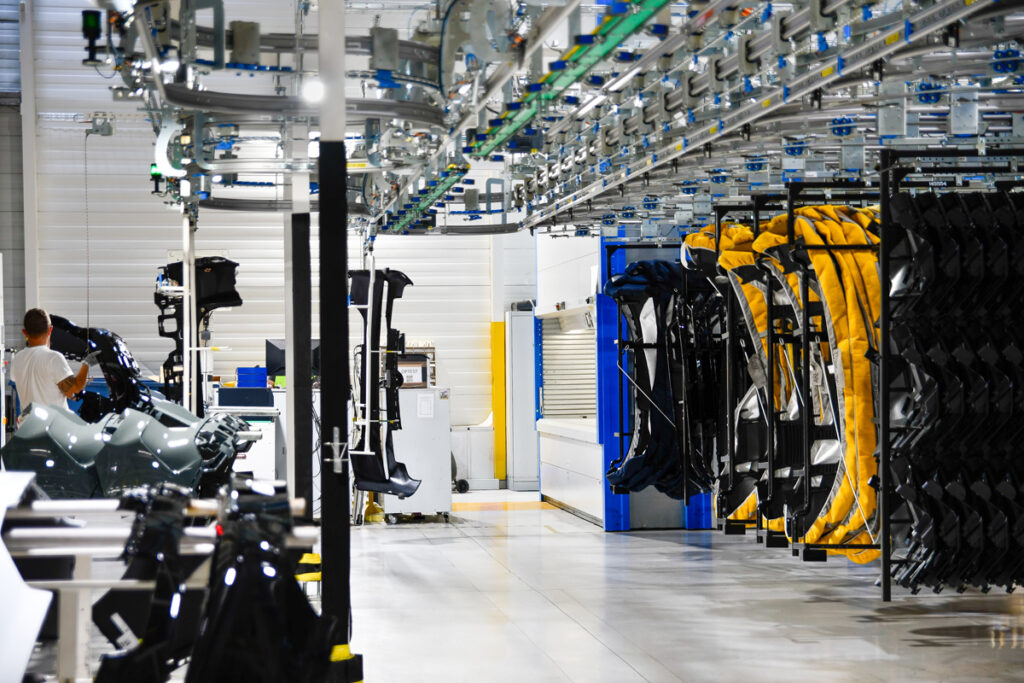
Intralogistics buffers serve exactly this purpose. They are not simply accumulation areas, but elements that allow processes with different behaviors to be decoupled and prevent variability from spreading uncontrolled. When properly located and sized, they act as regulators of the system.
Simulation, digitalization and adaptive systems
Optimizing flow between processes is not just about applying best practices. Experience helps identify problems, but it does not always anticipate how the system will respond to changes.
In systems where multiple variables interact, small decisions can have a significant impact on overall behavior. For this reason, specific tools are used to analyze and optimize these flows in a more structured way.
Among them, discrete event simulation makes it possible to reproduce system behavior before implementation. Based on real data, different scenarios can be evaluated, layout decisions validated, and elements such as buffers properly sized while considering operational variability.
In parallel, digitalization brings this level of control into the operational environment. Integration with MES and WMS systems provides visibility over material status and enables real-time coordination of the flow.
In more advanced environments, this integration goes a step further. The connection between operational technologies (OT) and information technologies (IT) allows the system itself to adapt its behavior based on real production conditions, product mix or demand. Flow is no longer static, but becomes more adaptive and less dependent on manual intervention.
That said, these types of tools do not always add value in the early stages of analysis. In many cases, simply observing how the system behaves is enough to determine whether the flow is properly structured or still relies on continuous adjustments. From there, it makes sense to go deeper with more advanced tools if the level of complexity requires it.
Maturity levels of flow between processes
Beyond advanced tools, it is possible to gain a clear understanding of flow performance simply by observing how the system behaves in practice.
The level of intralogistics maturity can generally be classified into three stages:
| Level | Description | System Behavior |
|---|---|---|
| Reactive Flow | Manual handling and improvised buffers | Unstable and dependent on human intervention |
| Assisted Flow | Partial structure and limited visibility | Stable under normal conditions |
| Controlled Flow | System-driven logic and real-time traceability | Predictable, efficient and scalable |
The key difference between these levels does not lie only in automation, but in how well flow is integrated into the overall system design.
A simple way to get started is to observe how your system responds in day-to-day operations. You can use this quick self-assessment to identify your current level of maturity:
If you are exploring ways to structure your flow between processes more effectively, we can help you approach it through real-world solutions for overhead transport and storage systems. Contact us.