


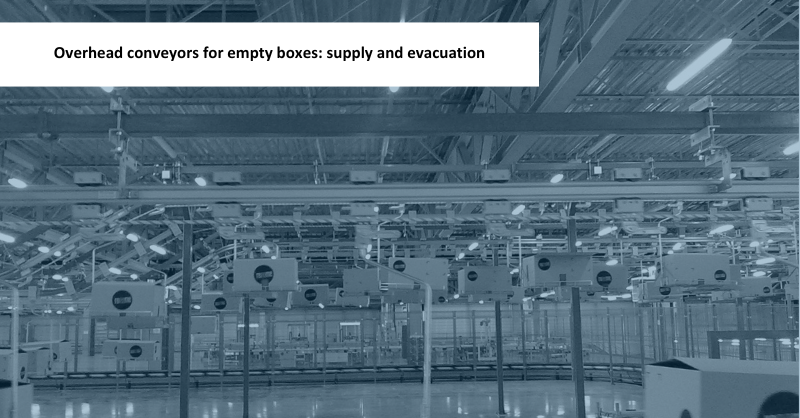
Empty boxes are part of many industrial and logistics processes. They are present in distribution centers, production lines, picking areas, and packing stations. Although they do not add direct value to the product, the way they are managed has a real impact on overall plant performance.
Beyond how they are organized, the key lies in how they are integrated into the flow. When this is not defined at the design stage, empty boxes tend to be handled reactively, influencing operations more than it may seem.
In this context, the supply and evacuation of empty boxes are no longer an auxiliary task, but become part of the intralogistics design. Overhead conveyors make it possible to integrate this flow in a continuous, organized way, without interfering with floor-level operations.
Empty boxes: from operational waste to a structured flow
In most industrial plants and warehouses, primary flows are carefully planned from the early design stages. However, auxiliary flows, such as empty boxes, are often addressed later, leading to improvised solutions that affect the overall balance of the process.
Rather than being waste, empty boxes represent a logistics flow with its own characteristics: they have an origin, a destination, and a pace directly linked to production. When managed reactively, they create disorder and inefficiencies; when properly designed, they integrate naturally into the system, improving ergonomics, freeing up productive space, and bringing greater stability to the overall operation.
This shift in perspective transforms a daily issue into an opportunity for intralogistics optimization, especially in environments where space, ergonomics, and flow stability are critical factors.
Why use overhead conveyors for empty boxes?
In many facilities, the flow of empty boxes shares space with people, forklifts, and other internal movements. It is not usually the biggest issue in the plant, but it is a constant source of small interferences that gradually affect overall performance: unnecessary movements, temporary accumulations, or areas that stop functioning as intended.
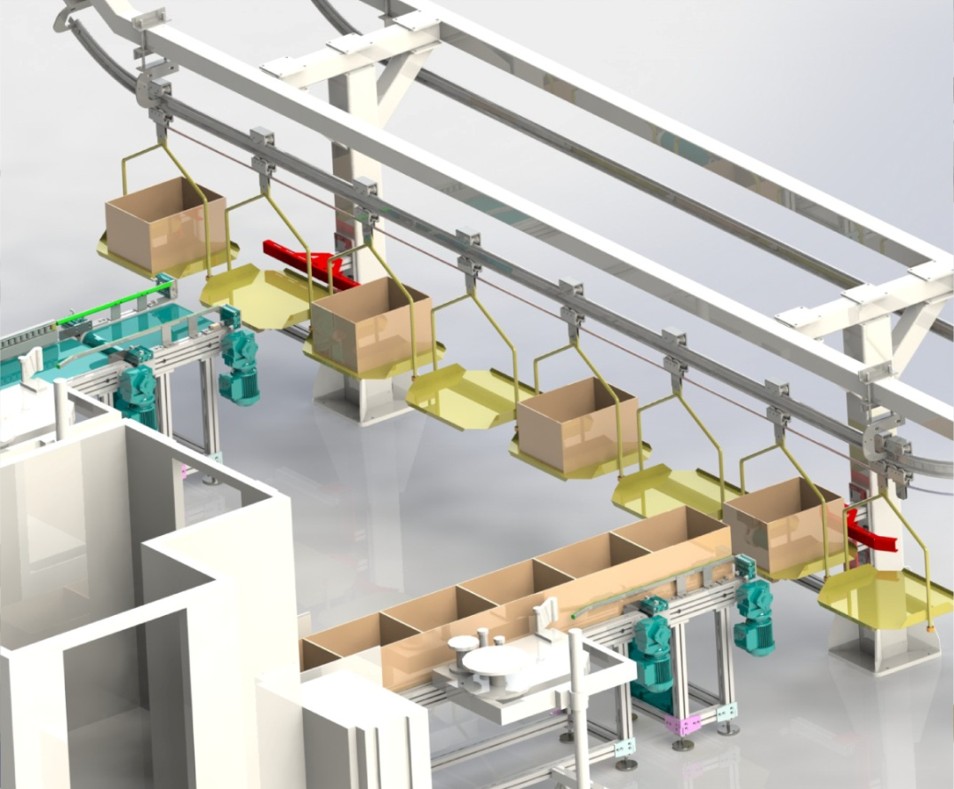
When this flow is moved to an overhead conveyor, it no longer competes for space.
Empty boxes begin to move continuously along a defined and predictable path, without relying on manual actions or causing interruptions in operations. Floor space is freed up, workstations are cleared, and the overall environment becomes easier to manage.
As a result, a large part of the manual handling associated with this flow disappears, reducing internal traffic and unnecessary interactions between operators and equipment. This not only simplifies operations, but also contributes to improved working conditions in terms of ergonomics and safety.
In addition, by operating above ground level, these systems can easily adapt to complex layouts, connecting different areas or levels without interfering with other flows. Whether in simple configurations or more automated environments, the system maintains stable and consistent behavior.
It is not just about moving empty boxes, but about ensuring they stop being part of the problem and become naturally integrated into the plant’s flow.
Overhead monorail conveyor: a simple, continuous, and reliable solution
In empty box handling projects, continuous towline monorail technology is one of the most widely used solutions due to its simplicity and reliability. It is designed for constant and predictable flows, where all load units move together with the traction element.
This operating principle ensures continuous movement without intermediate accumulation or routing decisions, providing stability and reducing operational complexity. At the same time, its design allows seamless integration into the day-to-day activity of the plant.
One of its key advantages is its ability to adapt to the available space, not only horizontally but also vertically. Through vertical curves and inclines, the conveyor can change levels and move at a height where it does not interfere with people, forklifts, or other equipment.
This makes it possible, for example, to lift the flow of empty boxes to a second level or route it above machinery and work areas, completely freeing the operating floor without affecting the rest of the installation. The system adapts to the layout, not the other way around.
Loading and unloading can be performed manually, even while the system is in motion, ensuring ergonomic and safe working conditions. At the same time, guided or automated loading and unloading stations can be integrated when required by volume or process conditions.
Thanks to its versatility, the overhead monorail conveyor can cover long distances, handle level changes, and adapt to complex layouts, offering low maintenance requirements and highly reliable operation.
This type of overhead conveyor is particularly well suited for empty box handling, where the objective is not sorting or accumulation, but maintaining a continuous, stable, and predictable flow.
Would this system fit your operation?
We’ll walk you through the solution and its possibilities.
Application examples: empty box supply and evacuation
The flow of empty boxes within a facility typically responds to two main needs: ensuring their availability at points of use or managing their evacuation once they have been used. While the technology applied is the same, the purpose behind it changes.
Empty box supply in distribution centers
In distribution centers or logistics environments with high picking rates, the priority is to ensure that boxes are always available at workstations.
In these types of facilities, the overhead conveyor acts as a continuous supply system, connecting box forming or storage areas with packing stations.
Boxes are introduced into the circuit through loading stations and distributed along the route. Operators take them based on real-time demand, while unused units continue along the circuit.
This approach decouples supply from the operator’s pace, preventing accumulation at the workstation and reducing the need for manual replenishment.
In facilities with a high number of SKUs and large volumes, this type of continuous flow brings greater stability to the process while keeping the floor free of auxiliary elements.
Empty box evacuation in pharmaceutical environments
In many processes, empty box handling is not about supplying them, but about continuously removing them from points of use to their recycling or disposal area.
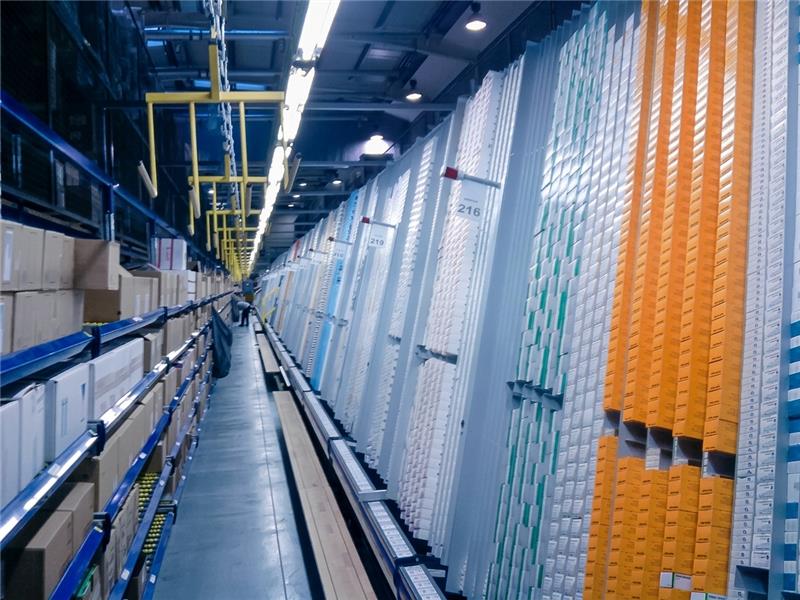
A clear example can be found in pharmaceutical environments, where order, cleanliness, and process stability are especially critical. In these types of operations, the accumulation of empty boxes at workstations is no longer a minor issue, but one that directly affects workspace organization and the ability to maintain consistent standards.
To address this, the system allows boxes to be loaded at different points along the route, collecting the flow in a distributed manner across the layout. From there, the conveyor transports all units to a centralized discharge area, where they can be evacuated through guided or automated systems.
The result is a flow that is collected almost without intervention, eliminating the need for manual internal transport and avoiding accumulation at workstations. Boxes are removed from the operational environment as they are generated, keeping the area clean, organized, and stable.
Although this type of solution is common in the pharmaceutical industry, the same approach applies to many other sectors where empty box evacuation must be handled continuously and without interference.
More than just a transport system, it acts as an integrated evacuation mechanism within the process, designed so that this flow no longer requires constant attention. In fact, many of our clients describe it quite simply as a “moving bin.”
Operational simplicity and process stability
In intralogistics, the most complex solution is not always the most efficient. In many cases, the best results are achieved with systems that directly match the behavior of the flow.
Continuous towline overhead monorail conveyors follow this principle. There is no intermediate accumulation, no routing decisions, and no variability in system behavior. The entire flow moves at a constant pace, aligned with the rhythm of the plant.
This operational simplicity results in lower variability, reduced dependence on auxiliary resources, and greater overall process stability.
Are your empty boxes part of the flow… or part of the problem?
The way empty boxes are handled can make the difference between a smooth operation and one affected by small frictions that repeat every day.
When this flow is properly integrated into the intralogistics design, it becomes a natural part of the process. It no longer requires constant attention or creates disruptions.
If you are evaluating how to optimize the supply or evacuation of empty boxes in your facility, analyzing this flow is often a good starting point.
Shall we talk? We can help you review your operation and define the most suitable solution for your process.