


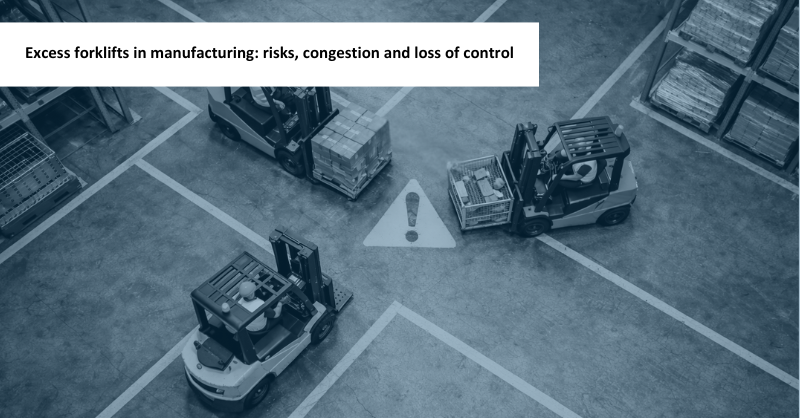
In many manufacturing facilities or warehouses, excess forklifts are rarely the result of a defined strategy. They are usually an accumulated consequence of growth. More volume, more SKUs, more points of consumption and, as an immediate response, more vehicles to move materials.
For a while, the solution works. The forklift is flexible, versatile and effective. It allows rapid adaptation to layout changes or demand peaks. But as the system continues to grow and the flow structure does not evolve at the same pace, that same flexibility begins to generate friction.
Congestion does not usually appear suddenly. It develops progressively. First as minor waiting times at intersections. Then as increasing difficulty in maintaining stable routes. Later as a persistent feeling that movement depends too heavily on real-time coordination.
At that point, the key question is not whether forklifts are useful. They are. The real issue is whether the system has started to rely excessively on free-moving floor vehicles to sustain its growing complexity.
The phenomenon of progressive saturation under excess forklifts in manufacturing
Every internal circulation network has a practical capacity, even if it is not formally defined in any document. As long as the number of movements remains within a comfortable range, the system can absorb variations without major consequences. But when the density of forklifts in circulation approaches its limit, the system’s behavior begins to change.
Beyond certain occupancy levels, the system no longer behaves linearly. It is enough for the average utilization of aisles and critical intersections to reach high levels for small deviations to generate cumulative delays.
This effect is well known in industrial environments: increased need for coordination, more micro-waiting times, and more urgent interventions.
Production may continue to meet targets, but operational margin is reduced. And when that margin disappears, any external disruption has a far greater impact.
When the number of forklifts stops being neutral
Adding a forklift is an apparently simple decision. It provides immediate transport capacity. However, when excess forklifts in manufacturing begin to normalize as a recurring solution, each additional vehicle does more than increase handling capacity; it also increases the number of potential interactions within the system.
More forklifts mean:
- More vehicle-to-vehicle crossings.
- More conflict points with pedestrians.
- Higher density in loading and unloading areas.
- More maneuvering in confined spaces.
Beyond a certain level of occupancy, the system no longer improves proportionally with each additional resource. Theoretical capacity increases, but effective capacity becomes constrained by interference between movements.
The result is a more complex and less predictable operating environment.
Safety: a limit that does not allow compromise
As forklift density increases, exposure to risk inevitably rises. This is not a cold statistical matter. It is a human one.
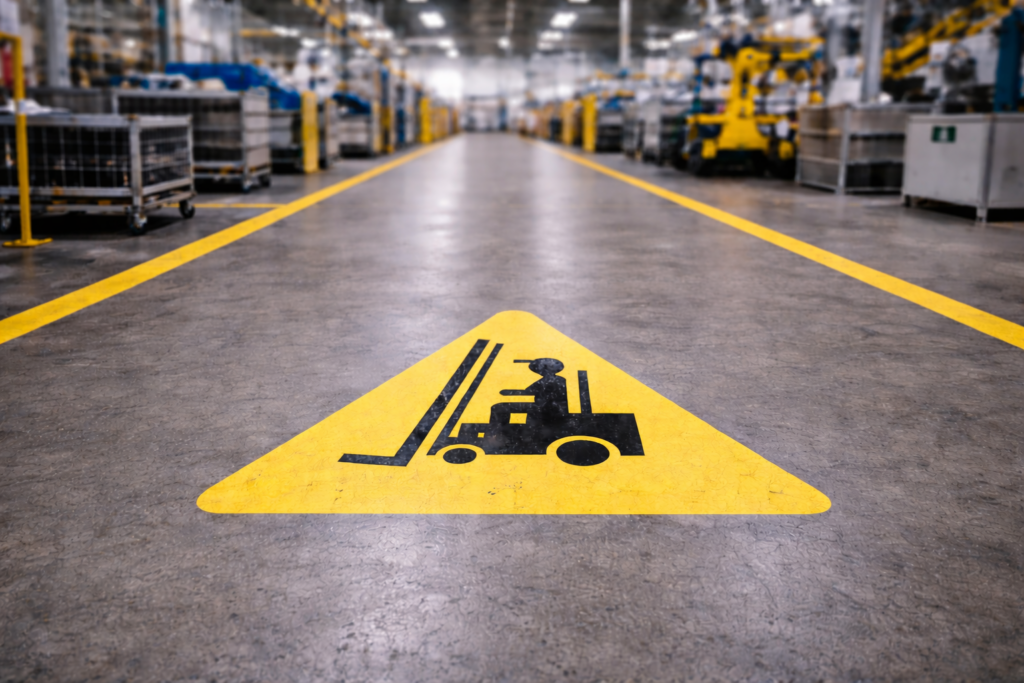
Every interaction between a vehicle and a person represents a potentially critical situation. In a low-traffic environment, these interactions are occasional and manageable. In a congested setting, they become frequent and concentrated in specific areas.
Reinforcing signage or reminding operators of traffic rules is not enough. If the system’s design generates too many interactions, structural risk increases.
Safety cannot rely solely on individual behavior. It must be supported by a flow architecture that minimizes unnecessary crossings and reduces cumulative exposure.
Safety is not negotiable. If forklift density is creating constant operational tension, the system requires structural review.
Operational variability and loss of predictability
Congestion does not only affect visible circulation. It also introduces variability into actual supply times. When routes depend on a saturated environment, delivery times become less predictable.
To protect production, the facility reacts by creating buffers: more intermediate stock, more accumulation near the line, and greater safety margins in planning.
That accumulation occupies space and adds complexity. The facility begins to allocate surface area to protect itself from its own transport system.
Over time, a circular dynamic develops: more forklifts generate more variability; variability leads to more accumulation; accumulation reduces available space; reduced space increases congestion.
Light parts and forklift use
In many industries, a significant share of internal movements involves light parts or subassemblies that do not require high load capacities. However, the dominant system remains the traditional forklift.
This means that vehicles designed for heavy loads are often used to transport flows that could potentially be handled differently. The result is a high level of floor occupancy for movements that do not always justify it.
The objective is not to eliminate forklifts where they are necessary. It is to assess whether all movements should rely exclusively on free-moving vehicles circulating on the floor.
Redistributing movement, not eliminating tools
The solution rarely lies in completely removing forklifts. In many processes, they will continue to be necessary.
A more robust approach consists of redistributing responsibilities within the logistics system. Instead of allowing all movements to depend on free-moving floor vehicles, part of the flow can be structured through systems that reduce direct interaction between vehicles and people, minimize critical crossings, and provide greater predictability.
In certain contexts, particularly where light parts and high SKU volumes are involved, structuring transport through dedicated solutions can reduce forklift density without sacrificing agility.
Reducing reliance on free-moving floor traffic does not mean reducing capacity. It means gaining control.
Could your flow extend beyond the floor?
We assess its suitability for your plant together.
Thinking beyond the short term
When congestion begins to affect safety, available space, and operational stability, it is time to review flow design from a structural perspective.
There are different intralogistics transport solutions that allow movements to be organized in a more stable way and reduce pressure on free-moving floor traffic. Making better use of the available building volume, separating critical flows, and structuring routes can make the difference between sustainable growth and growth that simply adds friction.
At Esypro, we develop overhead conveyors and hanging storage systems that help reorganize internal movement when forklift dependency starts to create structural congestion. In certain environments, these solutions make it possible to free up floor space, improve safety, and restore predictability to the flow.
The objective is not to indiscriminately replace forklifts. It is to ensure that the system does not rely exclusively on them to sustain its growth.
If your facility is beginning to experience high traffic density and you would like to assess how your current design could evolve to gain stability and safety, we would be pleased to analyze your case. Contact us.