


In many production plants and distribution centers, the same situation repeats itself. Empty boxes start piling up next to workstations, along aisles or in areas that were never designed for storage. Knowing how to organize empty boxes in industrial facilities becomes critical, because what begins as minor disorder often turns into a real operational problem.
Operators lose time moving boxes that are no longer needed or walking back and forth to fetch new ones. Usable space is reduced, material flows become harder to read and workstation ergonomics deteriorate. Over time, these small daily inefficiencies have a direct impact on productivity, safety and process stability.
Empty boxes do not add value to the product in industrial facilities, but managing them poorly certainly adds cost.
Why empty boxes become a problem
In most industrial facilities and distribution centers, empty boxes are a natural by-product of daily operations. They appear at packing stations, picking areas, assembly lines or kitting zones. The problem arises when their entry to or removal from the workstation is not considered during process design.
When this happens, a series of effects tend to repeat themselves and are quickly recognized by production and warehouse managers alike:
- Occupation of productive space by non-value-added material
- Loss of time due to unnecessary operator movements
- Poorer ergonomics at workstations
- Higher risk of interference and safety issues
- Lack of visual order and difficulty maintaining a stable layout
These frictions are not usually reflected directly in productivity KPIs, but they have a clear impact on real performance, day-to-day operations and the ability to sustain standards over time.
Common approaches to organizing empty boxes in industrial facilities
When a facility tries to address this issue, it usually turns to familiar and seemingly simple solutions.
One of the most common is manual handling. Empty boxes are stacked next to the workstation and periodically removed using carts, pallets or forklifts. This approach is easy to implement, but it consumes productive labor time and generates additional internal traffic.
Another frequent option is to create temporary accumulation areas for empty boxes. These zones act as buffers, but they often become saturated, especially during peak production periods. The problem does not disappear; it is simply shifted to another point in the facility.
Floor-level conveyors, such as belt or roller conveyors, allow empty box removal to be partially automated. They work well in stable layouts, but they take up productive floor space and limit future flexibility. In addition, they tend to concentrate the flow at specific points, which can lead to accumulation if the system is not properly sized.
More advanced solutions also exist, such as mobile robots that collect empty boxes and return them to a central area. These systems add flexibility, but they require higher investment and more complex management of internal traffic.
All of these approaches have one thing in common. They treat empty boxes as waste to be removed, rather than as a flow that needs to be designed.
A key idea: removing empty boxes from the floor
One of the most effective approaches from an intralogistics perspective is surprisingly simple. If empty boxes do not add value on the shop floor, they should not be there.
Moving this flow to an upper level helps free up space, reduce interference and restore clarity to the layout. For this reason, more and more facilities are turning to overhead transport solutions to manage empty packaging.

Overhead transport for empty boxes: when it makes sense
Overhead transport systems make it possible to move empty boxes following the actual layout of the facility, regardless of floor occupancy. They can cross aisles, clear obstacles, change elevation and connect different building levels without interfering with other flows.
This approach becomes particularly relevant when one or more of the following conditions apply:
- High consumption of empty boxes at multiple points across the facility
- The need to keep the floor clear for safety or housekeeping reasons
- Complex layouts or multi-level facilities
- Processes that require flow continuity and stability
- Environments where workstation ergonomics is a critical factor
In these scenarios, overhead transport stops being a one-off solution and becomes part of the structural design of the process.
The monorail conveyor. A simple, continuous solution
At Esypro, empty box handling is often addressed using an overhead monorail conveyor based on a high-strength Kevlar rope traction system. This type of solution is designed for simple, continuous flows, where the priority is not sorting or accumulation, as in Power & Free systems, but movement stability.
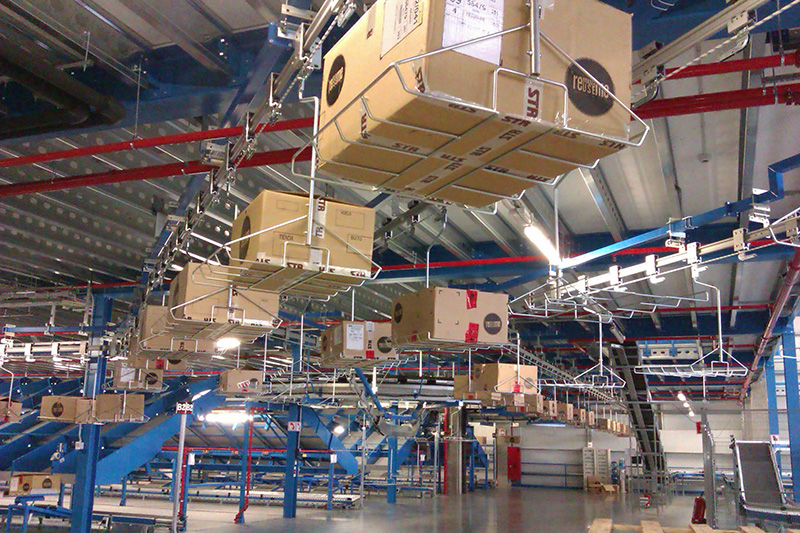
The operating principle is straightforward. Load units move together with the traction element, so the system behaves as a single, unified flow. When traction is active, all loads advance in a synchronized manner; when it stops, the entire flow comes to a halt. There are no intermediate accumulation points, which simplifies system behavior and control.
This approach is particularly well suited for empty boxes, as their transport does not require routing decisions. The objective is simply to move them in a constant, orderly and predictable way, aligned with the actual pace of the facility.
Conveyor speed is defined to allow manual loading and unloading even while the system is in motion, while maintaining safe and ergonomic conditions. In applications where volume justifies it, the system can also incorporate automatic loading and unloading devices without altering its continuous operating logic.
Thanks to its monorail design and the use of a Kevlar rope traction system, the conveyor requires very low maintenance and operates in a clean and simple manner. Through curves and elevation changes, it can cover long distances, adapt to complex layouts and connect different levels without occupying productive floor space.
Rather than being an automation solution in itself, this type of conveyor acts as a flow design element, intended to remove friction from day-to-day operations and restore process stability.
Are you looking for a solution to improve your intralogistics?
We can support you step by step
Comparison of solutions for managing empty boxes
To better understand when each alternative makes sense, the following comparison summarizes some key criteria to consider.
| Manual box handling | Floor-level conveyor (belt, rollers) | Overhead monorail conveyor | |
|---|---|---|---|
| Initial investment | Low | High | Medium |
| Maintenance cost | Low | High | Low |
| Floor space usage | High | High | Low |
| Ergonomics | Low | Medium | High |
| Flow automation | No | Partial | Yes |
| Long-distance transport | No | Limited | Yes |
| Adaptability to complex layouts | Low | Medium | High |
| Multi-level capability | Partial | No | Yes |
| Dependence on human resources | High | Medium | Low |
| Visual order on the shop floor | Low | Medium | High |
Organizing empty boxes in industrial facilities is not a minor detail
For many production and warehouse managers, empty boxes are not seen as a strategic priority. However, experience shows that poor management of this flow creates daily friction, wasted time and operational disorder. This is not simply a housekeeping issue.
If situations like these are part of the day-to-day reality in your facility, it is worth taking the time to step back and analyze them. Often, doing so with technical guidance is the best starting point. You can contact us to receive guidance on how to optimize empty box management in your facility.